
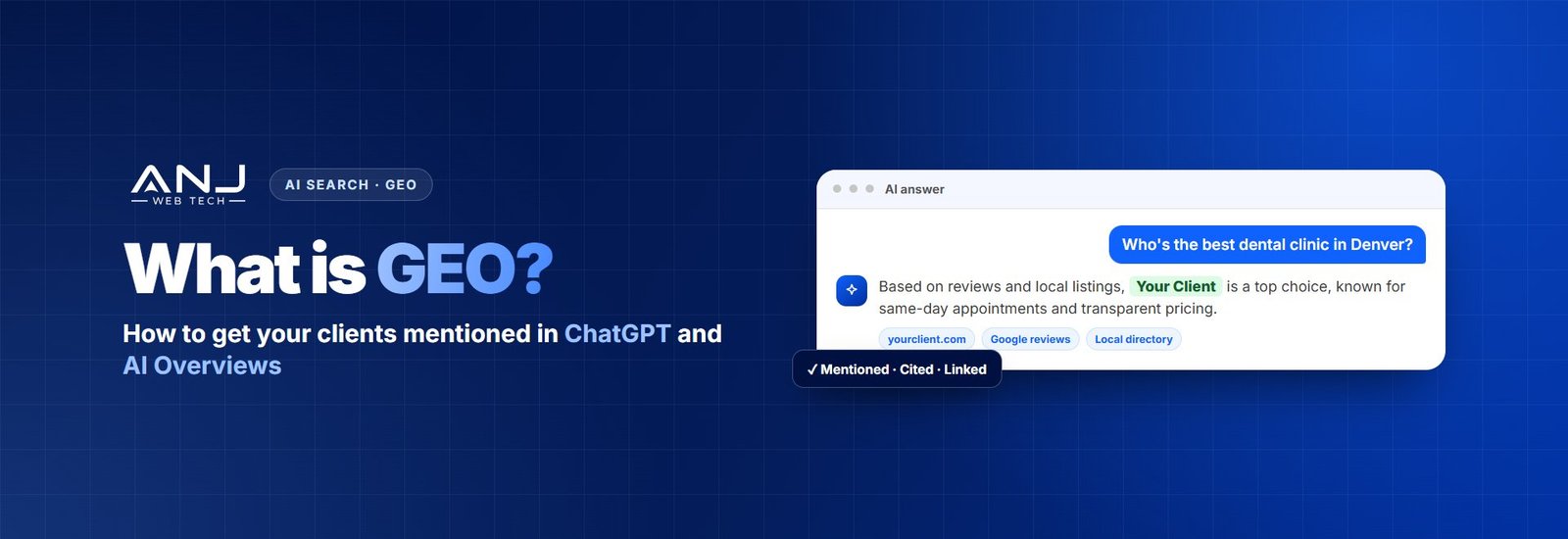
It’s a question more and more business owners are putting to their agencies: “When I ask ChatGPT for the best company in my city, why does it name my competitor and not us?”
Often the SEO is fine. Rankings are solid. But nobody has looked at how the business shows up inside AI answers. That gap has a name now: GEO. And if your clients haven’t asked you about it yet, they will.
Ranking gets you on the list. GEO gets you into the answer.
What is GEO?
GEO stands for generative engine optimization. It’s the work of making a brand easy for AI tools to find, understand and mention when they answer a question. That covers ChatGPT, Google’s AI Overviews and AI Mode, Gemini, Perplexity and Copilot.
You’ll also hear it called AEO (answer engine optimization) or simply AI SEO. The labels differ, but the goal is the same: when someone asks an AI a question your client should be the answer to, your client gets named.
How is GEO different from SEO?
GEO isn’t a replacement for SEO. It sits on top of it. AI tools still lean heavily on pages that search engines can crawl and trust, so a site with weak SEO rarely does well in AI answers. What changes is what you’re aiming for.
| Classic SEO | GEO | |
|---|---|---|
| The goal | Rank high in the list of results | Be named or quoted inside the AI’s answer |
| What wins | Relevance, links and a good page experience | Clear answers, consistent facts and mentions across the web |
| What you measure | Rankings, clicks and traffic | Mentions, citations, AI referral visits and enquiries |
| Where it shows up | Google and Bing results pages | ChatGPT, AI Overviews, Gemini, Perplexity, Copilot |
Why your clients will care
More people now get their answer straight from an AI summary without clicking through to a website. That changes what “being visible” means. A business can hold its rankings and still see fewer visitors, because the question was answered before anyone reached the results.
For an agency, this cuts both ways. Clients who only see a traffic chart may think your SEO stopped working. Clients who understand GEO will want someone to help them show up in AI answers. Either way, it’s a conversation you want to start before they do.
How to get your clients mentioned in AI answers
There’s no switch you can flip, and anyone promising guaranteed ChatGPT placement is overselling. But there’s a clear set of things that make a brand far more likely to be found and named. This is the order we work through them.
1. Make sure AI tools can actually read the site
Start with the basics. Check robots.txt isn’t blocking the crawlers that power AI search, such as OAI-SearchBot for ChatGPT search and PerplexityBot, along with Googlebot and Bingbot. Make sure important content is in the page itself, not hidden behind scripts, tabs that never load, or PDFs. If a crawler can’t read it, an AI can’t quote it.
2. Answer the question at the top of the page
AI tools pull out short, direct answers. So write the way people ask. Put a clear one or two sentence answer right under each heading, then add the detail. Use question-style headings that match what customers really type, like “How much does a dental implant cost in Denver?”, not “Our Pricing Philosophy”.
3. Add structured data
Schema markup tells machines exactly what a page is about: who the business is, where it is, what it sells, what the reviews say, which questions it answers. Organization, LocalBusiness, Service, Product, FAQPage and Article schema all help. It won’t get a brand quoted on its own, but it removes guesswork.
4. Keep the facts the same everywhere
AI tools cross-check. If the website says one phone number, Google Business Profile says another and an old directory lists a former address, the AI has less reason to trust any of it. Line up the name, address, phone, services and descriptions across the website, Google Business Profile, LinkedIn, review sites and directories.
5. Get mentioned on other websites
This is the one most teams underestimate. AI answers lean on what other sources say about a brand, not just what the brand says about itself. Reviews, industry directories, “best of” lists, local news, podcasts, partner pages and real discussions in forums all count. Digital PR and reputation work matter more for GEO than they ever did for classic SEO.
6. Show real expertise
Generic content that says what everyone else says gives an AI no reason to pick it. Original data, real examples, named authors with genuine experience, specific prices and clear opinions do. The content that gets quoted is usually the content that adds something new.
7. Keep content current
Out-of-date prices, old service lists and last year’s statistics make a page less useful to quote. Review key pages regularly, update them properly, and show the date they were last checked.
How to measure GEO
Measuring GEO is less tidy than tracking rankings, and it’s worth being honest with clients about that. What we track:
- A fixed set of test questions. Pick 20 to 30 questions real customers ask. Run them in ChatGPT, Gemini, Perplexity and Google every month, and note when the client is named, quoted or linked.
- AI referral traffic in GA4. Visits from chatgpt.com, perplexity.ai, gemini.google.com and copilot.microsoft.com show up as referrals. They’re often small in number but high in intent.
- Branded searches. People who meet a brand in an AI answer often search for it by name afterwards. Watch branded queries in Search Console.
- Enquiries. Add “How did you hear about us?” to contact forms, with an AI option. It’s the simplest proof there is.
Mistakes we see agencies make
- Promising rankings in ChatGPT. AI answers change from one person to the next and from one day to the next. Sell visibility work and honest tracking, not guarantees.
- Treating GEO as a one-off project. It works like SEO: steady effort, measured over months.
- Ignoring the basics. A slow, hard-to-crawl site with thin content won’t be fixed by adding an FAQ section.
- Chasing tricks. Files like llms.txt are cheap to add, but there’s little evidence yet that the major AI tools rely on them. Spend most of the effort on content, structure and reputation.
Offer GEO to your clients, under your brand
Most agencies we talk to know their clients will want this, but don’t have anyone on the team who can run it yet. That’s where we come in. Our SEO and AI search team handles the audit, the technical fixes, the content changes and the monthly tracking, and everything goes out under your agency’s name.
We’ve been a white label partner for digital agencies for over eight years, working with 78+ agencies today. We never contact your clients, every account is covered by an NDA, and plans run month to month.