
Most agency owners have heard of white label. Fewer know what it looks like day to day: who talks to whom, how work moves from your client to a partner and back, how you price it, and what stops it going wrong. That gap is why some agencies try white label once, have a bad experience, and never try again.
We’ve been the partner behind the scenes for digital agencies for more than eight years. This is how a good white label setup actually works, step by step, and what’s changing as we head into 2027.
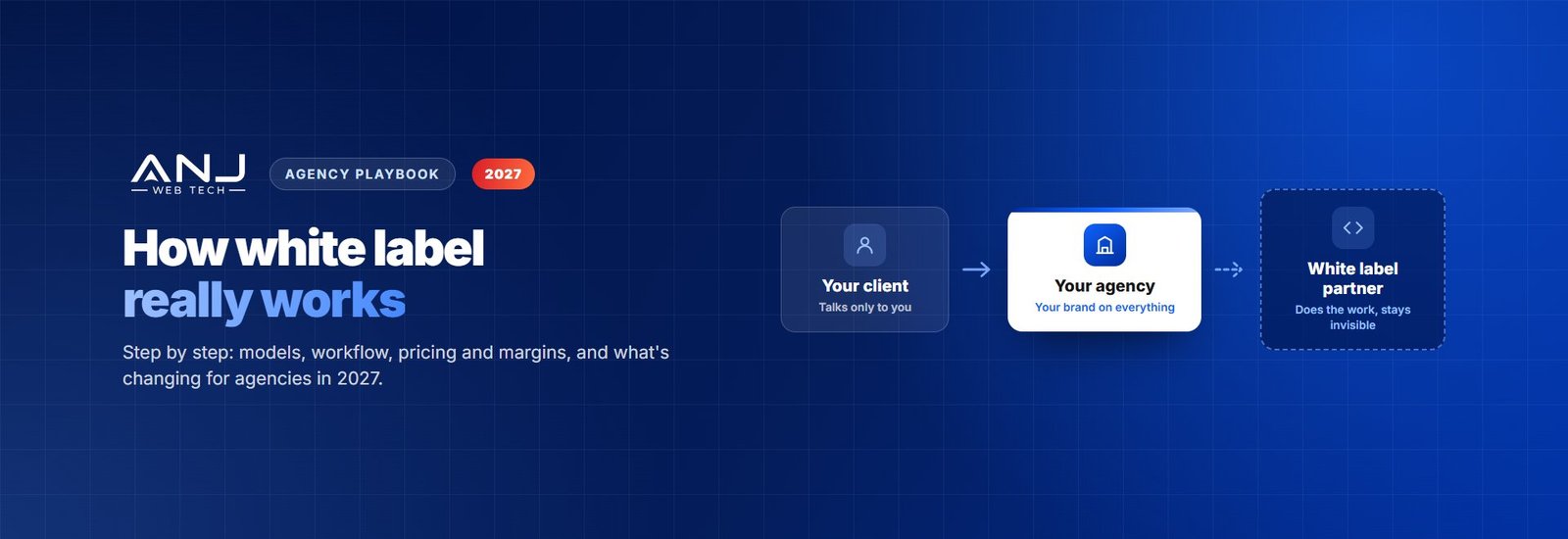
Your client sees your agency. Your partner sees your standards. Nobody sees the seam.
White label in one paragraph
A white label partner does work that your agency sells and delivers as its own. You keep the client, the relationship and the pricing. The partner builds the website, runs the SEO or sets up the campaigns, with your branding on everything and no contact with your client. To the client, it’s simply your agency doing great work.
The three ways agencies work with a partner
| Model | How it works | Best for |
|---|---|---|
| Per project | Each job is quoted and delivered separately | Occasional builds, or trying a partner out |
| Monthly plan | A set number of hours or a set scope every month, at a flat fee | A steady flow of work across several clients |
| Dedicated team | Specialists who work only on your accounts, full time | Agencies with a full pipeline that want an extension of their own team |
Many agencies start per project, then move to a monthly plan once they trust the partner and the work becomes regular. Monthly plans are also easier to budget for and easier to resell as a retainer.
How a job actually moves, step by step
- You win the work. Your agency sells the project or retainer, under your brand and at your price.
- You brief the partner. Goals, deadlines, brand guidelines, access to the client’s tools, and anything the client cares about. A clear brief saves more time than anything else on this list.
- The partner scopes it in writing. What’s included, what isn’t, how long it takes. You approve it before work starts, so there are no surprises later.
- A project manager runs it. One person on the partner’s side who knows your standards, keeps the work moving and updates you, so you’re not chasing several freelancers.
- The work gets built and checked. Specialists do the work, and someone other than the person who built it checks it before you see it.
- You review and present it. You ask for any changes, then deliver it to your client as your agency’s work.
- Ongoing work and reporting. Maintenance, SEO and campaigns continue month to month, with reports carrying your logo, not the partner’s.
Who talks to whom
This is the part that worries agencies most, so it’s worth being clear. Your client talks to you. You talk to your partner. A proper white label partner never contacts your client, never puts its name on deliverables, and works inside your tools: your project management system, your email domain if needed, your reporting templates. If the client ever asks, the work was done by “our development team”, and that’s true.
How to price white label work and keep a healthy margin
White label only works if the numbers work. Price from the value to the client and the time your own team still spends, not just the partner’s cost. Here’s a simple example with made-up numbers:
| Partner’s monthly plan | $2,000 |
| Your team’s time (account management, reviews) | $600 |
| Your real cost | $2,600 |
| What you charge the client | $4,500 |
| Your margin | $1,900 (about 42%) |
The mistake we see most is forgetting the middle line. Your own time on calls, reviews and client updates is a real cost. Count it, and price changes, extra rounds and rush jobs as extras, so scope creep doesn’t eat your margin.
What to sort out before you start
- An NDA covering your clients, their data and your methods
- Who owns the work: everything built for your clients should belong to you and them
- A no-contact rule: the partner never approaches your clients, during or after working with you
- Response times and working hours, especially if you’re in different time zones
- How to scale up, down or stop, and how much notice that needs
Your first 30 days with a new partner
- Week 1: sign the NDA, share access and brand guidelines, meet your project manager
- Week 2: send one real but low-risk task, such as a page build, an SEO audit or a fix list
- Week 3: review the work closely, give honest feedback and see how they respond to it
- Week 4: if it went well, hand over a bigger project or move to a monthly plan
Red flags to watch for
- No written scope, just “we’ll get it done”
- Nobody owns your account, so you’re always explaining things again
- Quality checks that depend on the same person who built the work
- Their branding showing up in code, reports or emails
- Long contracts that make it hard to leave if things don’t work out
What’s changing in 2027
- AI does the first draft; people do the finish. Good partners use AI to move faster on routine work, but the value is in the review, testing and finishing that clients actually pay for.
- New services to resell. Agencies are adding AI search optimization (GEO), AI automations and chatbots to their offer, and most need a partner to deliver them.
- Flexible capacity over fixed headcount. More agencies keep a small core team and use partners to scale up and down with demand.
- Proof over promises. Clients expect clearer reporting on results, so the partner’s reporting needs to make your agency look good.
How we work with agencies at ANJ Web Tech
We’re a white label delivery partner for digital agencies: websites, SEO and AI search, PPC, content and AI solutions. Today we work with 78+ partner agencies, with 100+ specialists on staff and 435+ websites delivered.
- One project manager who knows your standards
- Written scope before work starts, and quality checks before you see anything
- Your brand on every deliverable and report. We never contact your clients
- An NDA from day one, and month-to-month plans you can scale up or down